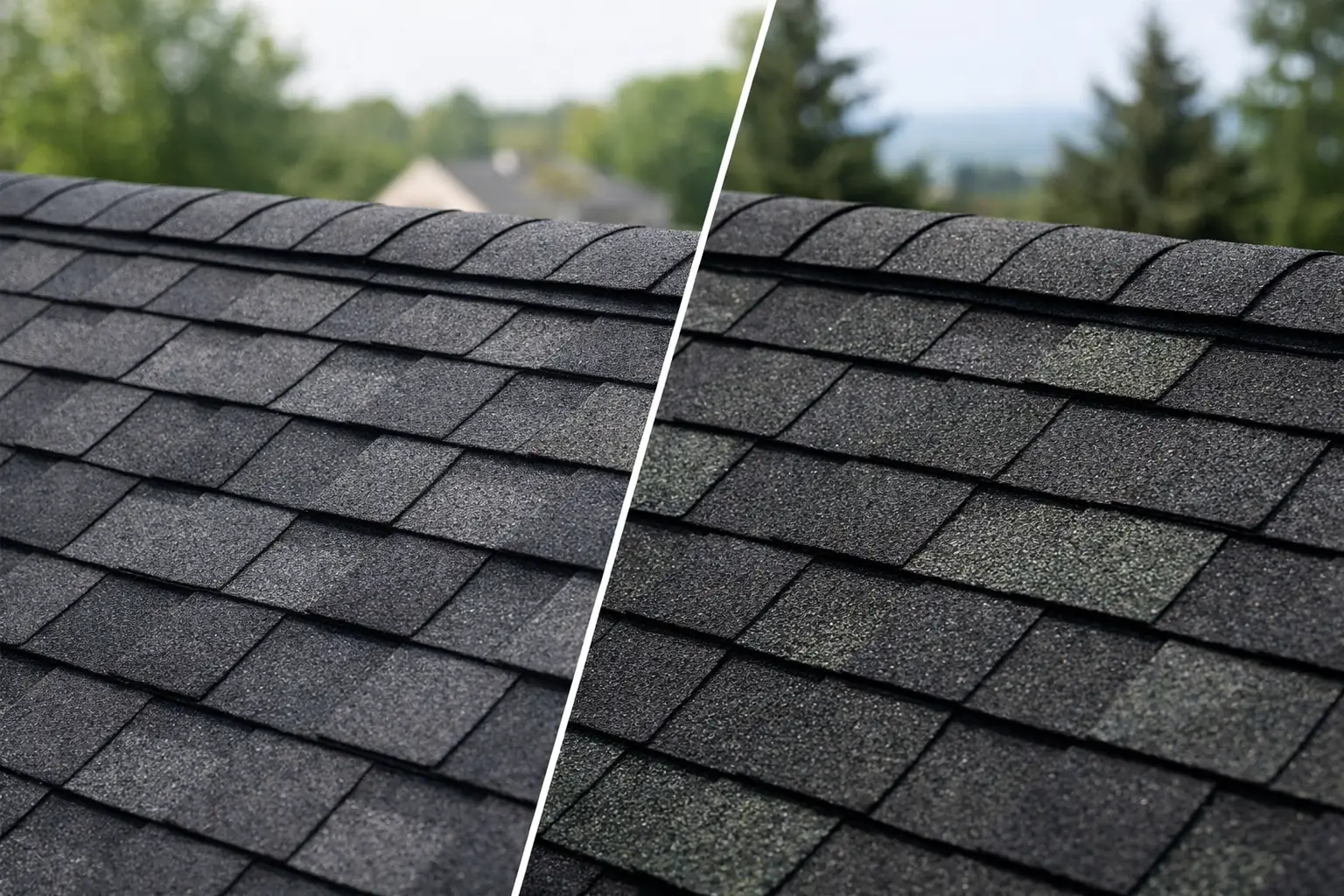
A roof on Vancouver Island has to manage more than the occasional heavy rain. It faces long wet seasons, moss-friendly shade, salt-laden coastal air in some neighbourhoods, and wind that can expose weaknesses in both materials and installation. In a GAF Timberline vs Malarkey Vista comparison, the better shingle is not simply the one with the longest feature list. It is the one that suits your roof design, budget, local exposure, and the level of protection you expect from a replacement.
Both are established architectural asphalt shingle lines with strong curb appeal and solid residential applications. The meaningful differences come down to impact resistance, material design, appearance, availability, and installed cost.
GAF Timberline vs Malarkey Vista at a glance
GAF Timberline is a broad family of architectural shingles. The specific product matters, but Timberline HDZ is commonly the baseline homeowners compare against other laminated shingles. It is designed to provide a dimensional wood-shake look, dependable wind performance when installed as part of an approved system, and algae resistance in applicable product configurations.
Malarkey Vista is also a laminated architectural shingle, but it is positioned more heavily around durability features. Vista uses a polymer-modified asphalt design and carries a Class 4 impact-resistance rating. It also includes Malarkey’s granule technology intended to help reduce airborne pollutants when exposed to sunlight.
For many homeowners, the simplest distinction is this: Timberline is often the practical, widely recognized architectural shingle option with extensive colour selection and system support. Vista is the more premium-leaning choice for homeowners who place added value on impact resistance and material flexibility.
That does not make Vista automatically right for every roof. A properly specified and carefully installed Timberline roof can be an excellent solution, particularly where budget, colour preference, and complete roofing-system compatibility lead the decision.
Weather performance that matters on the coast
Rain, moisture, and roof-system details
No asphalt shingle should be expected to solve moisture problems on its own. Shingles are only the visible water-shedding layer. Long-term roof performance depends just as much on the underlayment, ice and water protection at vulnerable areas, flashing, ventilation, penetrations, and accurate fastening.
This point matters on Vancouver Island. Persistent rain can expose shortcuts around valleys, skylights, chimneys, sidewalls, and eaves much faster than a drier climate. Whether you choose GAF Timberline or Malarkey Vista, a contractor should assess the full assembly rather than quote shingles as if they are the entire roof.
Malarkey’s polymer-modified asphalt is designed to remain more flexible than conventional asphalt, which can be useful through changing temperatures and during installation. GAF Timberline products are engineered for reliable residential performance as well, but the precise features vary by Timberline model. Compare the actual data sheet for the product being proposed, not the whole family name.
Wind exposure
Wind ratings are often discussed as a headline number, but they are conditional. They can depend on the shingle model, the approved fastening pattern, the number of fasteners, deck condition, roof geometry, starter products, ridge components, and whether the installation meets the manufacturer’s system requirements.
Both product lines can offer strong wind protection when correctly installed. For exposed coastal sites, ridge lines, open rural properties, and homes near the water, the conversation should include more than the published rating. Ask how the starter strip, hip and ridge caps, underlayment, and flashings will be handled. Those details help determine whether wind-driven rain stays outside where it belongs.
Algae, moss, and shaded roofs
Algae-resistant granules are useful, especially in damp climates, but they are not a moss-proof guarantee. Branch cover, shaded north-facing slopes, nearby trees, roof pitch, and drainage all influence how quickly biological growth appears.
GAF offers algae-resistance technology in relevant Timberline products, while Vista includes algae-resistance properties as part of its design. The practical takeaway is similar for both: keep gutters clear, limit overhanging vegetation where possible, and avoid treating the roof with harsh cleaning methods that can remove protective granules. If moss is already established, address it early and use a roof-safe approach.
The biggest difference: impact resistance
Malarkey Vista’s Class 4 impact-resistance rating is one of its clearest advantages. Class 4 is the highest rating in the commonly referenced impact test standard and is intended to indicate better resistance to hail-related impact under test conditions. Even though severe hail is less routine on Vancouver Island than in parts of the Prairies, impact resistance can still appeal to homeowners concerned about falling branches, windblown debris, and long-term material toughness.
Standard GAF Timberline HDZ shingles should not be assumed to carry the same Class 4 rating. GAF has product lines and options with different performance characteristics, so the comparison needs to remain product-specific. If impact resistance is high on your priority list, Vista generally has the more straightforward advantage over a standard Timberline HDZ selection.
Still, impact ratings do not promise that a roof will never be damaged. A large branch, poor attic ventilation, deteriorated decking, or an improperly installed shingle can create problems that no label fully prevents.
Appearance and colour selection
A roof covers a large portion of a home’s exterior, so colour deserves more attention than a small sample board receives. GAF Timberline is known for a broad range of architectural colours, making it easier to coordinate with existing siding, trim, stonework, and surrounding homes. For a renovation where matching an established exterior palette is the priority, that range can be valuable.
Malarkey Vista also offers attractive dimensional colours, often with noticeable blended tones that suit both traditional and contemporary homes. Its final look can feel slightly different depending on the roof pitch and the amount of direct light the home receives.
Before deciding, view full-size samples outdoors. A cool grey that looks crisp in a showroom may read blue in coastal light, while a warm brown can appear much darker across a broad roof plane. Consider the siding, fascia, gutters, brick or stone accents, and even the neighbouring landscape. The right colour should support the home rather than compete with it.
Cost and value: where the decision usually turns
Installed prices vary by roof size, pitch, access, tear-off requirements, disposal, deck repairs, flashing work, ventilation upgrades, and the accessories selected. A simple low-slope roof is not comparable to a steep, cut-up roof with multiple valleys and penetrations, even if the square footage is similar.
In many quotes, GAF Timberline HDZ will be the more budget-conscious option. It can provide a strong architectural-shingle result without moving as far into premium material pricing. Malarkey Vista commonly costs more, reflecting its Class 4 rating and polymer-modified construction.
The better value depends on what you are paying for. If you are replacing a roof on a straightforward home and want dependable protection, a proven architectural profile, and a carefully executed system, Timberline may make excellent sense. If durability features and impact resistance are worth a higher initial investment, Vista may justify the added cost.
Do not make the decision from a per-bundle price alone. Compare written scopes line by line. A lower shingle price can lose its advantage if the proposal leaves out proper underlayment, flashing replacement, ventilation corrections, or deck repairs required for a sound installation.
Warranty considerations without the fine print surprises
Manufacturer warranties can be helpful, but they are not a substitute for quality installation. Coverage periods, enhanced warranty eligibility, transfer terms, wind provisions, and exclusions differ by product and can change over time. Requirements may also differ between Canadian and U.S. programs.
Ask which exact shingle is being installed, which accessories are included, and whether the proposed assembly qualifies for any enhanced coverage. It is also reasonable to ask who is responsible if concealed deck damage is found after tear-off and how change work will be documented.
The workmanship side is equally important. A contractor who documents the roof condition, corrects defective details, and finishes penetrations and transitions cleanly protects the value of whichever shingle you choose.
Which shingle is right for your home?
Choose GAF Timberline when you want a recognized architectural shingle, flexible colour options, and a strong balance of appearance and cost. It is particularly compelling when the proposed system is complete and the roof’s primary needs are dependable water shedding, clean curb appeal, and professional installation.
Choose Malarkey Vista when Class 4 impact resistance and polymer-modified asphalt are priorities, and you are comfortable investing more in the material. It can be a sensible choice for homes with more exposure to debris, owners planning to stay long term, or homeowners who value its durability-focused design.
For either option, the roof deck and installation details deserve the final word. A well-built roofing system protects the home through wet seasons and changing weather far better than an upgraded shingle placed over overlooked problems. Start with an honest roof assessment, choose the product that fits your priorities, and insist on workmanship that gives the material its best chance to perform.
Leave a Reply