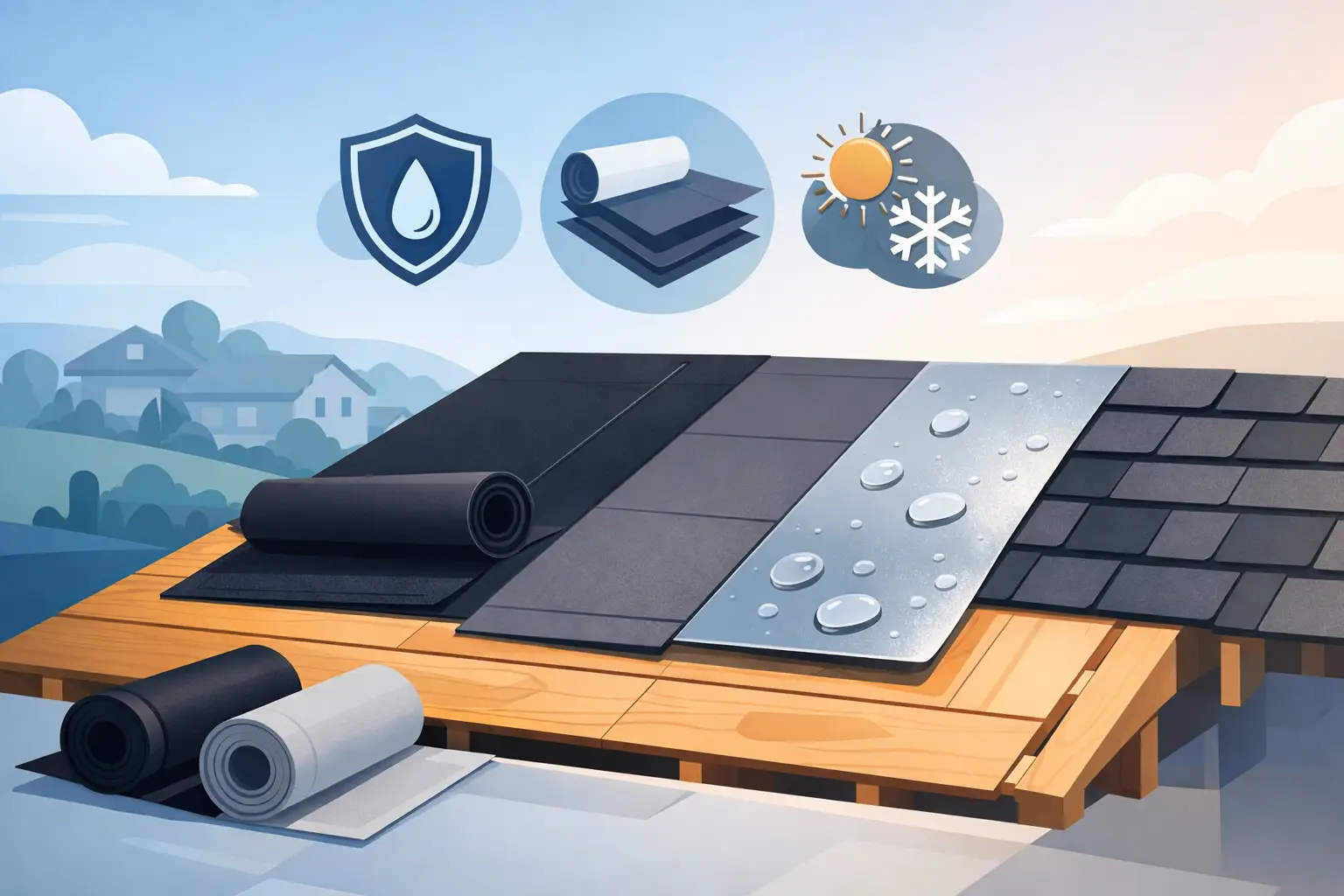
Most homeowners never see their roof underlayment, but when wind-driven rain gets under the shingles, it becomes one of the most important parts of the entire system. This guide to roof underlayment options explains what sits between your roof deck and outer roofing material, why it matters, and how to choose the right product for long-term protection.
Underlayment is the water-resistant or waterproof layer installed directly over the roof deck before shingles, metal panels, or other finished roofing materials go on. Its job is simple in theory and critical in practice – it adds a second line of defence if the outer roof covering is damaged, lifted by wind, or allows moisture through around fasteners, valleys, and transitions.
For homes exposed to frequent rain, damp conditions, and seasonal storms, underlayment is not just a technical detail. It plays a direct role in how well a roof handles moisture, how long the roof system lasts, and how much risk there is of hidden deck rot or interior leaks.
Why roof underlayment matters more than many homeowners think
Shingles and metal roofing are designed to shed water, but no finished roof covering works alone. Roof systems rely on layers, and underlayment is one of the most important of those layers. If water gets past the top surface, the underlayment helps keep that moisture from reaching the wood deck underneath.
It also helps during installation. If weather shifts before the final roof covering is fully installed, the underlayment can provide short-term exposure protection. That matters on real job sites, where a roof replacement may take more than a single day and coastal weather does not always cooperate.
There is also the issue of vulnerable roof areas. Valleys, eaves, around penetrations, and lower-slope sections often face higher water loads. Choosing the right underlayment in those areas can make the difference between a roof that performs well for years and one that develops avoidable problems early.
A guide to roof underlayment options for Canadian homes
Most residential roofing projects come down to three main underlayment categories: asphalt-saturated felt, synthetic underlayment, and self-adhered membrane, often called ice and water shield. Each has its place. The right choice depends on roof design, roofing material, slope, budget, and local weather exposure.
Asphalt-saturated felt
Felt underlayment has been used for decades and is still found on many homes. It is typically available in lighter and heavier grades, with the heavier products generally offering better durability during installation.
The main advantage of felt is familiarity. It has a long track record, and when installed properly as part of a sound roofing system, it can perform adequately. It is often less expensive than synthetic products, which can appeal to homeowners trying to control project cost.
The trade-off is durability and consistency. Felt can wrinkle when exposed to moisture, especially if it sits uncovered too long. It is also heavier, less tear-resistant, and generally less stable under demanding job-site conditions. In wetter climates, those limitations matter more.
Synthetic underlayment
Synthetic underlayment is now a common upgrade on residential roofing projects, and for many homes, it is the stronger all-around option. These products are typically made from engineered polymers designed to resist tearing, repel water, and hold up better during installation.
Compared with felt, synthetic underlayment is usually lighter, stronger, and easier to handle in larger rolls. It tends to lie flatter, resist wrinkling, and provide more reliable coverage when conditions are less than ideal. Many products also offer better walkability for installers, which can support safer, more precise workmanship.
That does not mean every synthetic product is equal. Quality varies by manufacturer, and specifications matter. Some are better suited for high-temperature applications, some for specific roof coverings, and some for longer UV exposure during construction delays. This is where proper product selection and contractor attention to detail become important.
Self-adhered membrane
Self-adhered membrane is the most water-tight option of the three. It bonds directly to the roof deck and seals around nails or fasteners more effectively than mechanically attached underlayments. It is commonly used at eaves, valleys, penetrations, and other high-risk areas.
Homeowners often hear this called ice and water shield, though product names vary. In colder regions, it is used to defend against ice damming. In wet coastal conditions, it also adds valuable protection where rainwater tends to concentrate or where wind-driven moisture is more likely to work in under the roof covering.
The main drawback is cost. It is more expensive than felt or synthetic underlayment, so it is not always used across the entire roof. In many cases, the best approach is strategic use – self-adhered membrane in vulnerable areas, paired with a high-quality synthetic underlayment on the rest of the roof.
Which roof underlayment option is best?
There is no single best underlayment for every roof. The right answer depends on how the roof is built and what kind of exposure it faces.
For a straightforward asphalt shingle roof on a well-pitched home, synthetic underlayment is often the best balance of performance, reliability, and value. It gives homeowners stronger water resistance and job-site durability than traditional felt without the full cost of covering the entire roof with self-adhered membrane.
For more vulnerable sections, especially eaves, valleys, skylights, chimneys, and roof-to-wall transitions, self-adhered membrane is often the smarter choice. Those areas see more water movement and deserve better protection.
For tighter budgets, felt may still be used, but it is worth understanding what you are trading away. Lower upfront cost can come with reduced tear resistance, more sensitivity to moisture during installation, and less dependable long-term performance in challenging weather.
What Vancouver Island homeowners should pay attention to
On Vancouver Island, roofs deal with long wet seasons, airborne moisture, and coastal weather that can expose even small installation mistakes. That makes underlayment selection more than a code checkbox. It is part of building a roof system that is actually suited to the environment.
In these conditions, synthetic underlayment and self-adhered membrane often make more sense than basic felt alone. A roof may look finished from the street, but the unseen layers are what support lasting protection. This is one reason quality craftsmanship matters so much. Good materials help, but they still need to be installed properly, lapped correctly, and integrated with flashing details that direct water where it should go.
The underlayment decision should match the whole roof system
A common mistake is treating underlayment as a stand-alone upgrade. In reality, it needs to work with the entire roof assembly. Ventilation, flashing, drip edge, decking condition, roof slope, and the finished roofing material all affect what product makes sense.
For example, a metal roof may require an underlayment with specific temperature tolerance. A lower-slope section may need more water-tight protection than the steeper main roof. If the existing roof deck has damage, replacing the underlayment alone will not solve the problem. Sound roofing decisions come from looking at the whole system, not one line item.
That is also why the lowest quote is not always the best value. Two roofing estimates can look similar on the surface while using very different underlayment products and installation methods. Asking what underlayment is included, where self-adhered membrane will be installed, and why those choices were made can tell you a lot about the care going into the project.
How to make a smart choice without overbuilding
Most homeowners do not need the most expensive product in every square foot of the roof. They need the right combination of protection in the right places. In many cases, that means a quality synthetic underlayment across the main roof area and self-adhered membrane in the sections most prone to leaks.
That approach respects both performance and budget. It avoids paying for unnecessary upgrades while still improving the parts of the roof system that carry the most risk. For a craftsmanship-focused contractor, this is usually the most sensible recommendation – build for real conditions, not sales language.
If you are comparing roofing proposals, pay attention to specifics. Ask what underlayment is being used, whether it suits your roofing material, and how high-risk areas will be protected. Clear answers usually reflect a contractor who understands that durable roofing starts below the shingles.
A roof is only as dependable as the layers beneath its surface, and underlayment is one of the places where careful decisions quietly protect your home for years.
Leave a Reply